What Is a Seven Flowers Bath? The 7 Flowers, Their Meanings, and Why Hong Kong Swears By It
In Hong Kong, there is a tradition passed down through generations: bathe in water infused with seven auspicious flowers, and you will draw happiness, love, and wealth into your life. It sounds like something your grandmother might whisper before Lunar New Year — and for many people, it is exactly that. The Seven Flowers Bath is one of those quiet folk rituals that has survived modernity not because people feel obliged to practise it, but because it works. It slows you down. It asks something of you — a pause, an intention, a moment of stillness. And the flowers chosen for the ritual carry both symbolic meaning and real botanical benefit.
Here is everything you need to know about the ritual, the flowers, and how to practise it today.
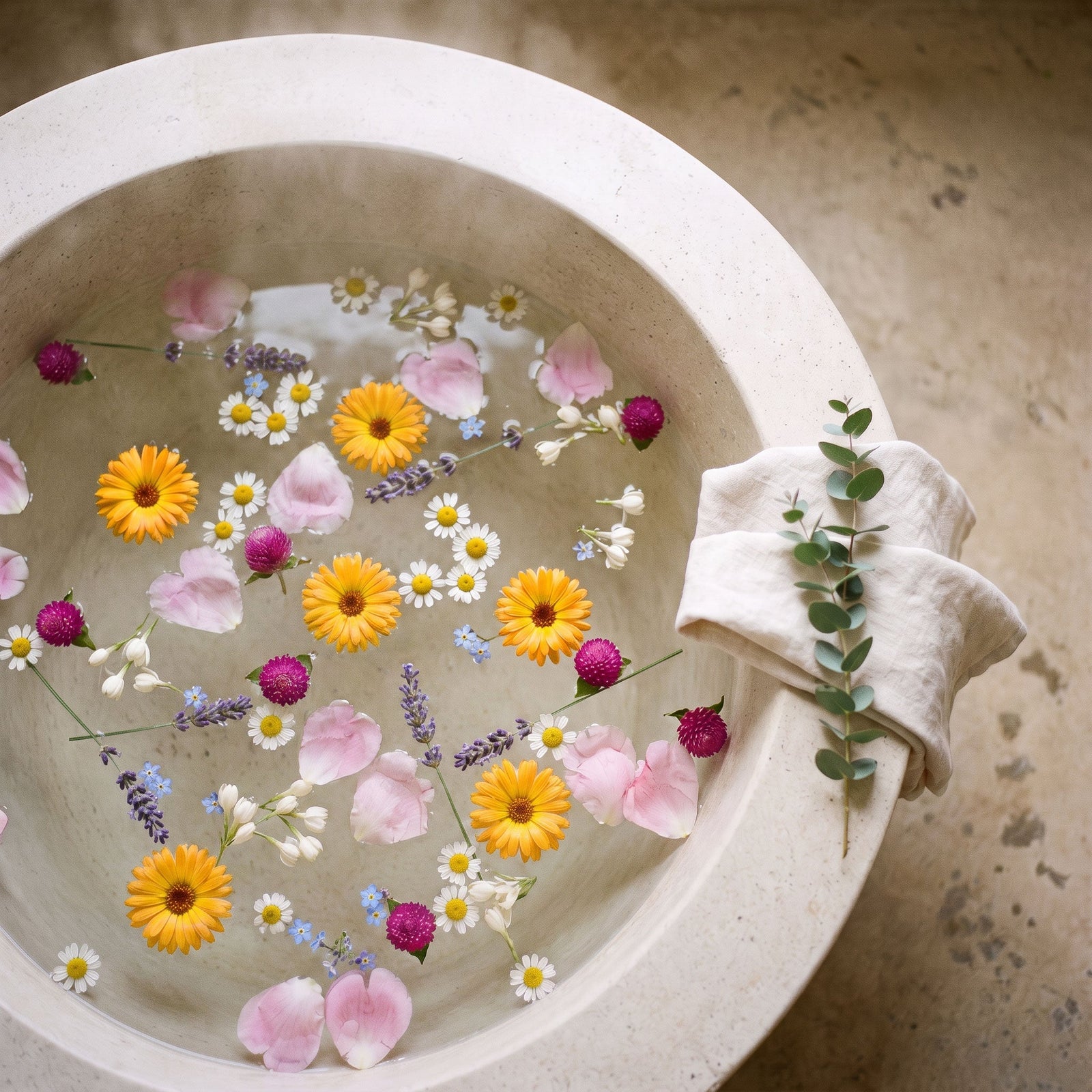
Seven botanical flowers, each carrying its own auspicious meaning — a ritual rooted deep in Hong Kong folklore
The legend: where the Seven Flowers tradition comes from
The Seven Flowers Bath is rooted in the belief that bathing with the petals of seven auspicious flowers can cleanse your aura, dispel negative energy (yin qi), and elevate your yang — the vibrant, positive life force that attracts good fortune. The ritual is especially popular in Hong Kong around Lunar New Year, at life transitions, and whenever someone feels spiritually heavy or stuck in a pattern they want to break.
While it is closely associated with Taoist practice in southern China and Hong Kong, the tradition of using plant-infused water for spiritual purification runs much deeper and wider than any single culture. In Malaysia and across Southeast Asia, flower baths have long been used in aura cleansing ceremonies. In India, bathing with flowers and herbs holds sacred significance in Hindu tradition — and there is a natural resonance with the concept of the Seven Chakras, the energy centres of the body that flowers and botanicals are believed to help balance and restore. The specific expression of the ritual differs by culture, but the underlying intuition is the same: nature, water, and intention together can shift something in you.
In traditional Hong Kong practice, people would visit the wet market, choose fresh blooms, and steep the petals in warm water. The act of selecting the flowers — deliberate, unhurried — was itself part of the ritual. Today, botanical extraction captures the same plant compounds more consistently through hydrosols, petal infusions, and essential oils. The spirit remains unchanged: you are not just washing your body. You are resetting your energy with intention.
What makes a flower right for the ritual?
One of the most common misconceptions about the Seven Flowers Bath is that you must use one specific fixed set of seven blooms. In practice, the tradition is more flexible than that. What matters is that the flowers chosen carry positive, auspicious meanings — softness, joy, love, purity, good fortune. The number seven itself holds symbolic significance (in both Chinese numerology and the Hindu chakra system), but the precise selection varies by practitioner, region, and what is available.
There is, however, folk wisdom about what to avoid. Roses are traditionally left out — despite their beauty, the thorns carry an energy that is not considered gentle or peaceful. Chrysanthemums, though lovely, are strongly associated in Chinese culture with grave-cleaning ceremonies and offerings to the deceased, so they are considered inauspicious for a ritual intended to invite positive energy in.
Across our range, we work with different flower selections depending on the product type and the ingredients best suited to each formula. The flowers that appear most consistently — chosen both for their auspicious symbolism and their genuine skin benefits — include:
Calendula (金盞花) — The flower of joy and optimism. Its warm golden petals are rich in antioxidants and exceptionally gentle on sensitive skin — one of the most widely researched flowers in natural skincare.
German Chamomile (洋甘菊) — The flower of calm. Chamomile is said to dissolve anxiety and create emotional stillness. Applied to skin, it soothes irritation and reduces redness — a flower that earns its peaceful reputation on multiple levels.
Lavender (薰衣草) — The universal symbol of purification. Lavender is said to clear stagnant energy from around the body. Its calming, grounding effect on the nervous system has been documented extensively in aromatherapy research.
Jasmine (茉莉) — The flower of love and attraction. Jasmine is considered one of the most spiritually potent flowers in Cantonese tradition: its sweetness is said to open the heart and make space for connection. In natural perfumery, Jasmine absolute is among the most complex and precious raw materials — a single flower with hundreds of aromatic compounds.
Forget-me-not (勿忘我) — The flower of sincerity and remembrance. It carries the wish that good fortune, once it arrives, will not be easily lost.
Globe Amaranth (千日紅) — Known as the "thousand-day red" in Chinese, Globe Amaranth represents longevity and fortune that does not fade. Its vivid colour holds even when dried — a living symbol that the blessings you call in should be lasting ones.
Peony (牡丹) — The queen of flowers in Chinese culture. Peony represents wealth, honour, and feminine vitality, and is one of the most auspicious blooms in any traditional good-luck ritual.
How to practise the Seven Flowers Bath today
The modern version of the ritual is simpler than the traditional wet-market approach, and the botanicals are more consistent. You do not need to source fresh petals. What matters is the intention, the flowers themselves — captured in the formula — and the time you give yourself to slow down.
Draw a warm bath or step into a warm shower. Breathe slowly before you begin. Set a quiet intention — something you are calling in, or something you are releasing. Let the warmth of the water and the botanicals do their work. Our Seven Flowers products are scented with a signature blend of pure essential oils — Jasmine, Geranium, Ylang Ylang, Petitgrain, Cedarwood, Vetiver, and Benzoin — added not because the flowers themselves are strongly fragrant, but because the ritual deserves a scent that feels as considered as everything else in it.

Ritual Body Cleanser
Seven Flowers Body Soap
Natural plant oils infused with seven organic flower petals — Calendula, Chamomile, Lavender, Jasmine, Forget-me-not, Globe Amaranth, and Peony. Scented with Jasmine, Geranium, and Ylang Ylang pure essential oils. Made in Hong Kong.
If you have dry or sensitive skin, the MILD version combines an amino acid-based cleansing formula with seven flower hydrosols — floral water distilled directly from each petal — alongside Trehalose, Sorbitol, and Allantoin for deeper hydration and skin barrier repair. The same ritual, even gentler and more moisturizing.

Ritual Body Cleanser — Sensitive Skin
Seven Flowers Body Soap MILD
Seven flower hydrosols with Trehalose, Sorbitol, and Allantoin for hydration and barrier support. Free from SLS, silicones, and artificial fragrance. Formulated for dry and sensitive skin. Made in Hong Kong.
Carrying the ritual beyond the bath
The Seven Flowers tradition does not have to end when you step out of the shower. The same auspicious energy can fill the space around you — your home, your commute, your presence throughout the day.
The Seven Flowers Home Mist combines seven flower hydrosols with Colloidal Silver, a natural antimicrobial, in a light sprayable mist. Spritz it onto your clothing, into the corners of your room, across your linen before sleep, or in the air before meditation or journalling. The floral-earthy scent shifts the atmosphere of a space almost immediately. Think of it as the olfactory equivalent of opening a window and letting something stale out.

Aromatherapy Room Mist
Seven Flowers Home Mist
Seven flower hydrosols with Colloidal Silver and a pure essential oil blend. Instantly uplifts and freshens any room. No artificial fragrance. 100ml. Made in Hong Kong.
For a ritual you can carry with you close to your skin, there is the Seven Flowers Perfume. This Eau de Parfum is formulated entirely from natural essential oils — free from artificial fragrances and chemical fixatives. The opening is Petitgrain, bright and clean; The heart is a layered floral of Jasmine Absolute, Geranium, Ylang Ylang, Neroli, Wild Chamomile, Clary Sage, and Lavender; the dry-down settles into Cedarwood, Benzoin, and Vetiver — warm, quietly grounding, the kind of scent that stays close to skin rather than announcing itself across a room. Which feels appropriate for something intended to carry personal intention.

Eau de Parfum — All Natural
Seven Flowers Perfume
Built entirely from natural essential oils: Petitgrain, Jasmine Absolute, Geranium, Ylang Ylang, Neroli, Wild Chamomile, Lavender, Clary Sage, Cedarwood, Benzoin, Vetiver. No synthetic fragrance. 30ml. Made in Hong Kong.
Frequently asked questions
What is a Seven Flowers Bath and where does it come from?
The Seven Flowers Bath is a ritual purification practice in which you bathe with seven auspicious flowers to cleanse negative energy and attract happiness, love, and good fortune. In Hong Kong it is closely tied to Taoist folk tradition, but the practice of using flower-infused water for spiritual cleansing is found across many cultures — including ceremonial plant baths in Malaysia and other parts of Southeast Asia, and purification rituals in Hindu tradition that share a natural connection with the concept of the Seven Chakras. The ritual is especially popular around Lunar New Year and at personal turning points, though many people practise it year-round.
Does the ritual require specific flowers, or can I choose any seven?
The tradition is more flexible than many people expect. What matters is that the flowers carry auspicious, positive meanings — softness, joy, love, purity, prosperity. There is no single fixed list. That said, there is folk wisdom about what to avoid: roses are traditionally left out because their thorns carry an energy that is not considered gentle, and chrysanthemums are associated with grave-cleaning ceremonies in Chinese culture, making them inauspicious for this ritual. Beyond that, the choice of flowers is yours.
Is it better to use fresh flowers or a product?
Traditionally, fresh petals were steeped in warm water. However, fresh bouquet flowers sold today are often heavily treated with pesticides to keep them looking perfect — we have heard from customers who tried the ritual with fresh flowers and experienced skin rashes or allergic reactions as a result. For this reason, we only use food-grade dried flowers (several of which are certified organic), flower hydrosols, and pure essential oils in our products. The botanical compounds are preserved, the quality is consistent, and your skin is not exposed to agricultural chemicals.
When is the best time to do a Seven Flowers Bath?
Any time you feel energetically heavy, stressed, or want to mark a new beginning. The ritual is most popular around Lunar New Year and before important life events, but many people make it a monthly or even weekly practice. There is no single rule — the ritual works whenever you approach it with focus and give yourself real time to slow down.
Do the Seven Flowers products have a scent?
The seven flowers themselves — whether used as dried petals, hydrosols, or extracts — do not produce a strong or distinctive fragrance on their own. Rather than leave the products unscented, we developed a signature essential oil blend for the entire Seven Flowers series: Jasmine, Geranium, Ylang Ylang, Petitgrain, Cedarwood, Vetiver, and Benzoin. It is a warm, floral-earthy scent that is pleasant without being overpowering — subtle enough that it does not define the experience, but present enough to make the ritual feel intentional.
The Seven Flowers Perfume and Perfume Oil go further. Because a perfume cannot incorporate hydrosols or flower extracts the way a body soap can, we brought in seven distinct flower essential oils to honour the seven flowers concept within the formula itself. The result shares the same warm core as the series signature scent, but is noticeably more layered and complex — a proper floral composition with greater depth and elegance that unfolds over time on the skin.
Can anyone practise the Seven Flowers ritual, or is it specifically Chinese?
The ritual has roots in Cantonese folk tradition, but it is fundamentally about intention, botanicals, and taking time to care for yourself — things that translate across cultures. Many of our customers who love the Seven Flowers range are not of Chinese heritage but are drawn to the ritual's slowness and the quality of the natural ingredients. It is yours to practise however feels meaningful to you.
Complete the ritual: Seven Flowers Fortune Tea
After your bath, steep a cup. Phoenix Dan Cong Oolong blended with the same seven auspicious flowers — Chamomile, Calendula, Lavender, Hibiscus, Butterfly Pea Flower, Jasmine, and Peony. A ritual in two parts, from bath to cup.
Shop Fortune Tea — HK$238